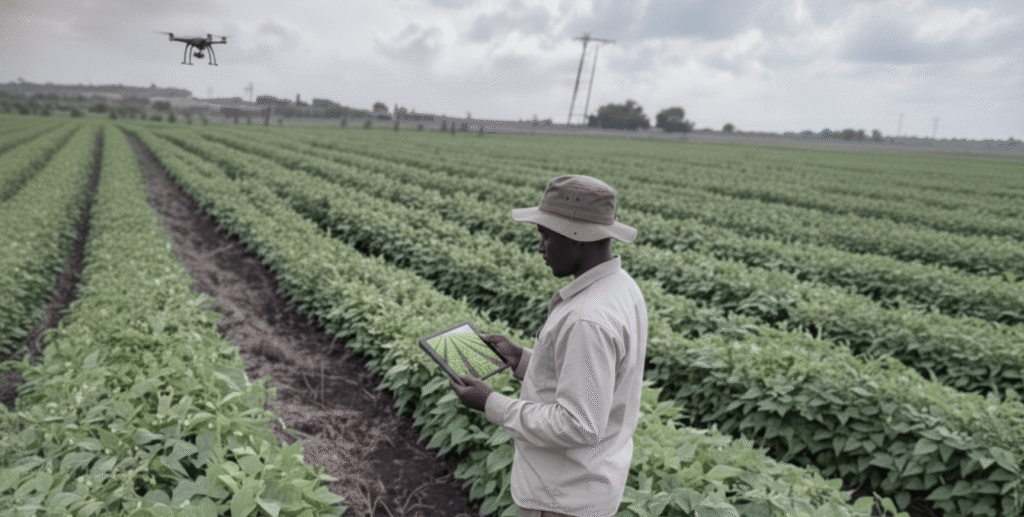
Moving Beyond Farming to Building a Business
For decades, farming has been the backbone of Nigeria, employing nearly half of the working population(Trade.gov). Yet, despite all this effort, our country still struggles to feed itself securely. This is a paradox: we have millions of farmers, but too many people go hungry.
The problem is that most of us are stuck in “subsistence farming” ,i.e. just growing enough to feed our families(Subsistence Definition).
The real key to Nigeria’s food future is Agribusiness.
Agribusiness is simply treating farming as a commercial operation, connecting every step, from the seed in the ground to the food on the table, into a strong, profitable value chain. This shift is not just about growing more; it is about protecting your harvest, getting fair prices, and making farming profitable for generations to come.
1. The Harsh Reality: Metrics from Your Farm (2024-2025)
The current economic situation shows just how fragile traditional farming is. The average smallholder farmer is being crushed by rising costs and huge losses, making it almost impossible to earn a decent living.
A. The Crisis of High Costs
In 2024, the cost of farming inputs which are the essential items you need to plant, skyrocketed. This inflation means that even if you harvested a good yield, your profit margin shrunk or disappeared entirely.
Based on national data, the costs of essential fertilizers saw dramatic increases between 2023 and 2024 (NAERLS 2024 Survey):
| Fertilizer Type | Average Cost Increase (2023 to 2024) | Percentage Increase |
| NPK | ₦25,400 to ₦42,000 | 65.4% |
| Urea | ₦22,350 to ₦41,300 | 84.8% |
These spikes directly raise the cost of producing staple crops. For example, the cost of producing a hectare of Maize jumped by 69.7% in 2024, and Rice production costs rose by 37.8%(NAERLS 2024 Survey). This tough economic reality is one reason why food inflation is so high, forcing poor Nigerian families to spend up to 70% of their income just on food(World Bank).
B. Productivity and Post-Harvest Loss
The sheer amount of food wasted or lost after harvest is one of the biggest roadblocks to food security. Because of poor storage and inadequate transport, an estimated 35% to 45% of all crop yield is lost to pests and diseases(NAERLS 2024 Survey). Imagine losing nearly half of your hard work and income before it ever reaches the market.
Furthermore, regional studies confirm that African farmers have faced systemic struggles. Empirical research across sub-Saharan Africa found no evidence that crop productivity improved over a 12 year period (2008 to 2019), with some regions even seeing declines(PNAS Study). Without increased efficiency and yield, we cannot feed our nation.
2. Structural Barriers: Why Growth Is Stalled
For farming to become Agribusiness, these three major roadblocks must be removed:
A. The Challenge of Financing
If you want to move from subsistence to commercial farming, you need capital—money to invest in better seeds, fertilizer, or equipment. However, accessing formal loans is extremely difficult:
- Bank Exclusion: The agriculture sector receives less than 4% of total bank credit in Nigeria.
- Rural Gap: Over 60% of rural communities surveyed do not have a bank branch or an Automated Teller Machine (ATM)(Veriv Africa Finance).
This exclusion forces farmers to turn to informal money lenders who charge outrageous interest rates, often ranging from 10% to 100%(Veriv Africa Finance). Such high cost credit prevents any real commercial growth. While the government sets aside funds for agriculture, supervisory bodies must enforce standards to ensure those funds are actually managed well and reach the smallholders who need them(GSCAR Finance).
B. Insecure Land and Investment Fear
Why should a farmer invest their savings and sweat into making their land better if they are afraid of losing it?
Land tenure security is a huge problem. Data shows that only 4% of sampled smallholder farmers in Nigeria have formalized their land ownership by registering it with the land registry(Frontiers Study). The vast majority (about 96%) lack the formal title that provides security.
Research shows that having a secure title to your land is a necessary condition for a farmer to adopt long term “Resilient Farming Practices” (RFPs) like agroforestry or permanent irrigation(Frontiers Study). Without that title, farmers are hesitant to commit capital and labor for improvements, fearing they might be evicted and their investment lost(Frontiers Study).
C. Poor Infrastructure and Mechanization
Inadequate infrastructure, like poor roads and unreliable power, increases the cost of logistics and makes it hard to move your produce to markets(AgriFood Networks). This issue is closely linked to post-harvest loss.
Furthermore, many farmers want to mechanize but face barriers (NAERLS 2024 Survey):
- High hiring costs for equipment.
- Tractor unavailability.
- Lack of genuine spare parts across multiple states.
3. The Agribusiness Key: Strategic Pillars for the Future
Agribusiness offers clear, practical solutions focused on efficiency, technology, and market access.
A. The Power of Water and Irrigation
Since only about 1% of Nigerian cropland is currently irrigated, most farming relies solely on rainfall, making us vulnerable to climate change(IFPRI Irrigation).
The biggest single investment that can transform farming is small scale irrigation. Modeling shows that expanding irrigation systems to just 4% of Nigeria’s arable land could generate over $600 million in increased income for farmers during the dry season alone(IFPRI Irrigation). This allows for year-round production, creating reliable income and a stable food supply. The government has noted the need to strengthen collaboration to expand irrigation systems(Minister’s Statement).
B. Technology for Better Yields
Farmers must adopt modern technology to bridge the yield gap.
- Precision Farming: Precision agriculture tools are now gaining traction. For instance, the use of drone based multispectral sensors for field level scouting and targeted input application is estimated to have an adoption rate of 15% among Nigerian farmers in 2024, and this is expanding every year(Farmonaut Tech). These tools help you use less fertilizer and get a better return on your investment.
- Digital Extension: To overcome logistics barriers, mobile based extension programs, especially using low-cost text messages, are proving highly effective for teaching millions of smallholders about modern farming practices(VoxDev Study).
C. Digital Finance and Market Access
Using technology to provide financial services to farmers, Agri-FinTech is directly tackling the finance gap. Nigeria’s Agri-FinTech Lending Platforms Market is currently valued at approximately $600 million(Ken Research).
Platforms like ThriveAgric use technology called the Agricultural Operating System (AOS) that works entirely offline. This system digitizes commodities, helps with credit scoring, and links farmers directly to capital and local and global markets(ThriveAgric AOS). This type of innovation bypasses the need for traditional bank collateral, making finance accessible to smallholders.
4. Real African Success Stories
Successful models show that commercial farming and technology can work for smallholders across Africa:
- Fighting Loss with Science: IITA (International Institute of Tropical Agriculture) developed Aflasafe, a technology that consistently reduces a dangerous poison called aflatoxin in major crops (maize, groundnuts) by 80% to 100%(IITA Aflasafe). This is vital for meeting quality standards needed for high value export markets.
- Local Innovation: Nigerian startups are applying drone technology for precision services like yield estimation and targeted input application(CSC UK Case Study).
- Targeting Smallholders: Organizations like the One Acre Fund are committing to reaching 1 million smallholder farmers in sub-Saharan Africa by 2027 using digital tools to improve productivity and resilience(One Acre Fund). Crucially, they focus on gender-smart agriculture, ensuring that women make up over 50% of their clients to strengthen community resilience(One Acre Fund).
- Modern Advisory: Innovative advisory services are moving beyond traditional extension offices. By leveraging platforms like WhatsApp and other ICT tools, one program successfully delivered knowledge exchange to over 60,000 smallholders cost effectively(NIBIO Study).
From Subsistence to Sovereignty
Nigeria’s food crisis is not a production problem; it is a business and structural problem. We cannot achieve food security by asking smallholders to work harder in a system that is rigged against them by high costs, huge post-harvest losses, and financial exclusion.
Agribusiness is the answer because it transforms farming from a struggle for survival into a stable, profitable enterprise.
To secure our food future, we must:
- Prioritize Water: Invest urgently in small scale irrigation to move away from unreliable rainfed farming and guarantee year round harvests(IFPRI Irrigation).
- Secure Land: Expedite formal land titling to motivate farmers to invest in long term improvements on their land(Frontiers Study).
- Use Technology: Embrace digital finance platforms and precision tools (like drones(Farmonaut Tech) and mobile extension(VoxDev Study)) to reduce waste, boost yields, and access fair credit.
By making these strategic shifts, Nigeria can unlock the massive potential of its farmers, transforming the agricultural sector from a source of fragility into a dynamic engine of economic growth and true food sovereignty for the nation.